From WWW to MMM: Naming the Web, Naming Intelligence
Article Metadata
Author
Philip Tsang
Affiliations:
Nextus Institute of Science & Technology, Sydney, Australia
Corresponding author: drphiliptsang@gmail.com
Abstract
The naming of the World Wide Web evolved through three distinct forms—WorldWideWeb, World‑Wide Web, and World Wide Web / WWW—each reflecting a different phase in the Web’s emergence: software prototype, architectural system, and global infrastructure. Drawing on primary sources including Berners‑Lee’s 1991 announcement, Cailliau’s 1995 architecture poster, IW3C2 documentation, and early Australian Web‑education contributions, this paper reconstructs the cultural and institutional dynamics encoded in the Web’s naming. It then proposes a parallel triad for the AI era: Model • Memory • Meaning (MMM), a naming framework that captures the computational, persistent, and semantic layers of modern machine intelligence. By placing WWW and MMM side‑by‑side, the paper argues that the Web organised information, while AI organises intelligence, marking a transition from the Information Web to the Intelligence Web.
Keywords
- World Wide Web history
- WWW naming conventions
- Model Memory Meaning (MMM)
- intelligence architecture
- IW3C2
- APWWW’95
- Web historiography
1. Introduction
The World Wide Web is widely studied as a technological, social, and economic phenomenon. Yet the evolution of its name—from WorldWideWeb to World‑Wide Web to World Wide Web / WWW—remains largely undocumented. Naming practices encoded engineering pragmatism, administrative precision, and institutional standardisation during the Web’s formative years. Naming is never neutral: it reflects the assumptions, constraints, and priorities of the communities who shape a technology. In the Web’s case, each naming form corresponds to a distinct phase in its emergence—the software prototype, the architectural system, and the global infrastructure. This paper reconstructs the logic behind these naming transitions using primary sources from 1991–1996, including Berners‑Lee’s early postings, Cailliau’s architectural diagrams, IW3C2 documentation, and Australian Web‑education contributions. The second half of the paper proposes a successor naming triad for the era of artificial intelligence: MMM — Model, Memory, Meaning. As WWW organised information, MMM organises intelligence. The paper argues that the shift from WWW to MMM marks the transition from the Information Web to the Intelligence Web, where semantic coherence, contextual reasoning, and multi‑agent interaction become the defining features of digital systems.
2. Primary Sources and Methodology
The analysis draws on four classes of primary sources. First, engineering artefacts such as Berners‑Lee’s 1991 alt.hypertext announcement, NeXTStep interface conventions, and early HTTP documentation provide insight into the naming practices of the prototype era. Second, architectural representations including Cailliau’s 1995 CERN poster visually encode request/response cycles, connection closure, and the Web’s layered architecture. Third, institutional documents—IW3C2 membership rosters, WWW5 proceedings, and APWWW’95 organisational materials—trace how naming stabilised through governance bodies. Fourth, pedagogical sources such as CSU’s Internet Special Projects Group (ISPG) papers, TECFA/WWW1 workshop materials, and early Australian Web‑education syllabi reveal how naming conventions entered teaching practice and public discourse.
These sources are analysed using a triadic historiographical method: form analysis examines naming conventions as engineering artefacts; function analysis maps naming forms to architectural roles; and institutional analysis traces how naming was standardised through committees and documentation. This method reveals that naming transitions were not stylistic accidents but reflections of deeper structural shifts in how the Web was conceived and governed.
3. Berners‑Lee’s Usage: WorldWideWeb as Software
Berners‑Lee’s earliest naming, WorldWideWeb, reflects the constraints and habits of NeXTStep programming. Fused naming was common in object‑oriented environments where class names, interface elements, and executable identifiers followed CamelCase conventions. The fused form therefore encoded the Web primarily as a program, not yet as a system.
This naming choice reveals three aspects of early Web culture. First, it signals software identity: the Web was initially experienced as a specific application running on a particular platform. Second, it reflects engineering pragmatism: naming aligned with NeXTStep UI conventions and developer workflows. Third, it embodies prototype culture: rapid iteration, minimal documentation, and informal naming practices were typical of early development.
Even within the same 1991 announcement, Berners‑Lee alternates between “WorldWideWeb” and “World Wide Web,” revealing an early conceptual split between software and system. This oscillation foreshadows the later transition from fused to spaced naming as the Web’s identity expands beyond a single executable into a distributed architecture.
4. Cailliau’s Usage: World‑Wide Web as Architecture
Cailliau’s hyphenated form, World‑Wide Web, appears consistently in CERN documentation and reflects a shift from software to architecture. The hyphen performs two functions. Structurally, it emphasises the Web as a distributed system composed of distinct components. Stylistically, it aligns with CERN’s technical writing standards, which favoured compound forms in formal documentation. Cailliau’s 1995 poster visually encodes the Web’s architectural logic: request, response, connection closure, and the separation of client and server roles. The hyphenated naming mirrors this architectural clarity, positioning the Web as a coherent, engineered structure rather than a single program. In this phase, the Web is understood as a system of systems, and naming shifts accordingly from fused software identity to articulated architectural identity.
The coexistence of Berners‑Lee’s fused form and Cailliau’s hyphenated form illustrates how different communities—developers, documenters, and architects—projected their own priorities onto the Web’s name. Naming thus becomes a site where engineering pragmatism and architectural formalism intersect.
5. IW3C2 Usage: World Wide Web / WWW as Institutional Standard
By 1994–1996, the Web had transitioned from a research project to a global infrastructure. The International World Wide Web Conference Committee (IW3C2) adopted the spaced form World Wide Web and the acronym WWW, marking the naming’s institutional stabilisation. This shift reflects the Web’s new role as a public, global system that required linguistically neutral and internationally recognisable terminology.
The spaced form emphasised readability and universality, aligning with conference proceedings, standards documents, and public communication. Acronyms such as WWW, HTTP, and URL became part of a broader ecosystem of standards, signalling the Web’s integration into formal governance structures. Naming here is no longer the product of individual developers or local documentation practices; it is the outcome of institutional negotiation and global coordination. The adoption of “World Wide Web / WWW” thus marks the Web’s transition from prototype to infrastructure—from a tool used by a small technical community to a platform underpinning global information exchange. Naming stabilises as the Web’s identity stabilises.
6. Naming as Cultural, Institutional, and Social Expression
The evolution from WorldWideWeb → World‑Wide Web → World Wide Web / WWW mirrors the Web’s transition from prototype → architecture → global system. At the same time, it reflects shifts in culture and governance: from individual developer practice to institutional documentation to international standardisation. Naming can therefore be read as a form of cultural and institutional expression. In the prototype phase, naming reflects engineering culture—pragmatism, speed, and informal conventions. In the architectural phase, naming reflects administrative culture—documentation precision and structural clarity. In the infrastructure phase, naming reflects institutional culture—governance, standardisation, and global accessibility.
This triadic evolution provides a template for analysing other socio‑technical systems: names change as systems move from experimental artefacts to structured architectures to globally governed infrastructures. The WWW naming trajectory thus becomes a lens through which to understand the Web’s emergence as a socio‑technical system embedded in engineering, administrative, and institutional worlds.
7. Early Australian Web Teaching: TECFA/WWW1 and APWWW’95
Australian contributions to early Web education are often overlooked in global historiography. CSU’s Internet Special Projects Group (ISPG), TECFA/WWW1 workshop participants, and APWWW’95 organisers played a pivotal role in developing early Web‑education syllabi and integrating Web technologies into regional Australian contexts.
ISPG’s work on Mosaic/WWW experiences with library science students, TECFA/WWW1 education workshops in Geneva, and the Asia‑Pacific WWW Conference (APWWW’95) in Sydney collectively demonstrate that Web naming and Web teaching were intertwined. As educators introduced the Web to new audiences, they had to choose between fused, hyphenated, and spaced forms, implicitly reinforcing particular conceptualisations of the Web—as software, architecture, or infrastructure. Photographic evidence from APWWW’95—showing Tim Berners‑Lee and ISPG delegates holding Wagga Wagga Council T‑shirts, Yuri Rubinsky and Ira Goldstein wearing the shirts, and Joseph Hardin, Ira Goldstein, Jean‑François Abramatic, and Berners‑Lee in discussion—reveals that regional deployments such as Wagga Wagga were woven into the Web’s early social fabric. These images situate Australian Web‑education efforts within the broader narrative of the Web’s global emergence and provide the historical backbone for the conceptual bridge from WWW to MMM.
8. The Wagga Wagga Contribution
Photographic evidence from early conferences shows Tim Berners‑Lee and ISPG delegates holding Wagga Wagga Council T‑shirts, Yuri Rubinsky and Ira Goldstein wearing the shirts, and Joseph Hardin, Ira Goldstein, Jean‑François Abramatic, and Berners‑Lee in discussion. These images reveal that regional deployments such as Wagga Wagga were woven into the social and institutional fabric of the early Web.
One surviving composite transparency from APWWW’95, reproduced from a reversed print, shows delegates holding Wagga Wagga shirts, attending a sold‑out WACCA gathering, and interacting during conference social events. The mirrored lettering is a direct consequence of analogue reproduction workflows—front‑and‑back acetate transparencies photocopied into a single image—and is preserved as part of the historical record.
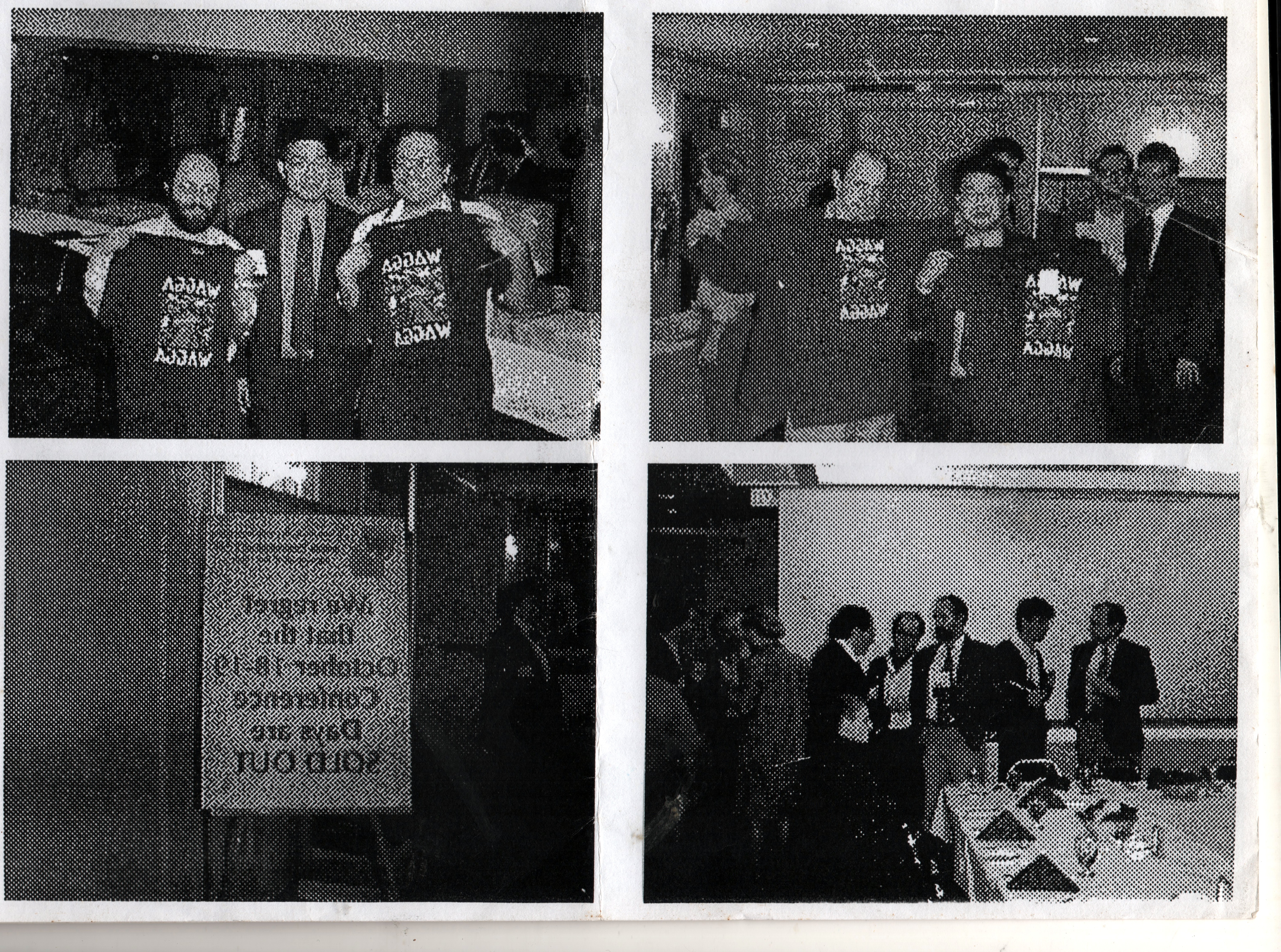
This exhibit captures the hands‑on, improvisational nature of early Web culture and the regional identity woven into APWWW’95.
9. From WWW to MMM: A Naming Framework for Artificial Intelligence
As WWW encoded the organisation of information, MMM encodes the organisation of intelligence. The proposed triad—Model, Memory, Meaning—captures three layers of modern machine intelligence: computation, persistence, and semantics.
Model (Compute)
The Model layer represents the computational engine that predicts, generates, and reasons. It includes neural architectures, optimisation procedures, and inference mechanisms. In the same way that early Web servers and clients instantiated the WWW architecture, contemporary AI models instantiate the computational core of MMM.
Memory (Retain)
The Memory layer represents the persistence mechanisms that store, adapt, and contextualise knowledge. This includes vector databases, long‑term memory modules, and user‑specific adaptation layers. Memory allows AI systems to move beyond stateless interaction toward continuity, history, and personalised context.
Meaning (Interpret)
The Meaning layer represents the semantic and pragmatic capacities of AI systems: interpreting intent, nuance, and multi‑agent interaction. Meaning is where intelligence becomes social and contextual, enabling AI systems to participate in human workflows, institutional processes, and collaborative reasoning.
10. Visual Continuum: WWW and MMM Posters
The paper is accompanied by a side‑by‑side visual comparison of WWW and MMM:
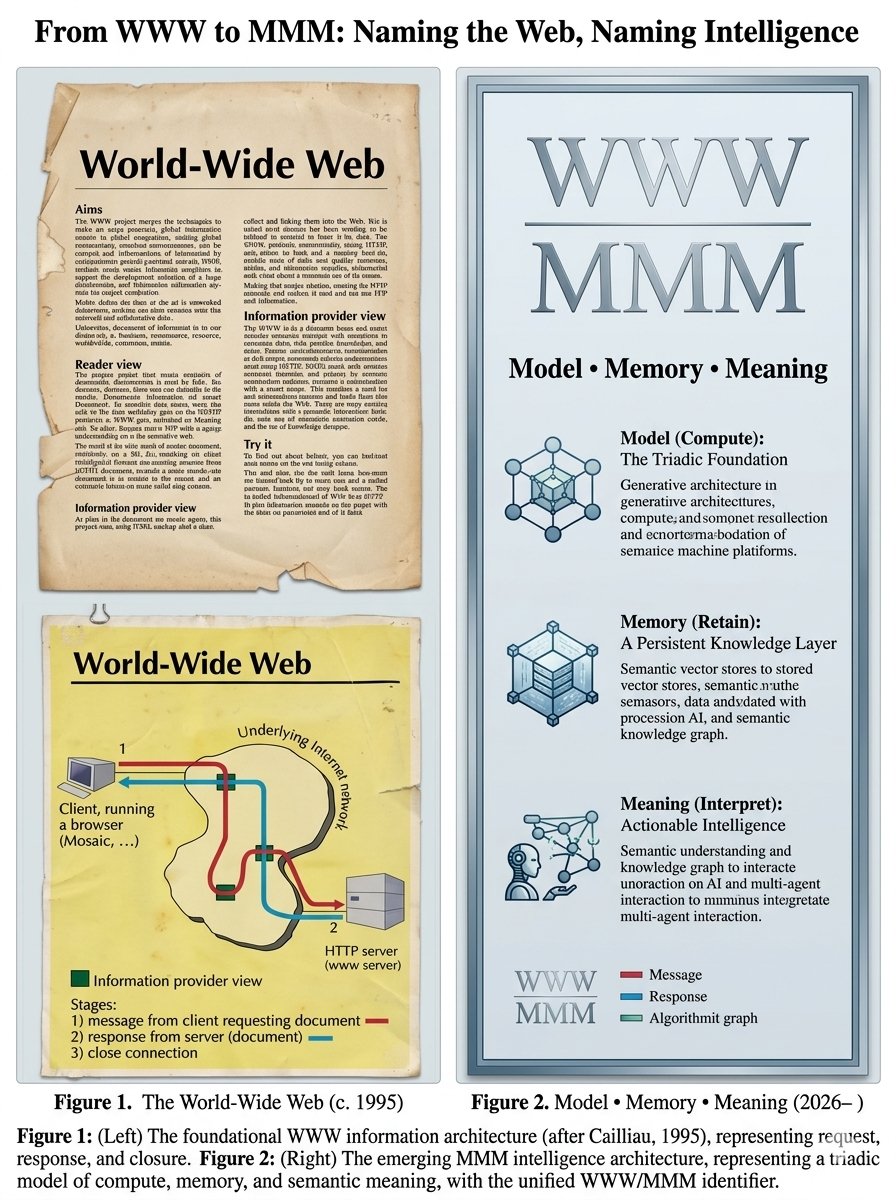
Placing Figures 1 and 2 side‑by‑side makes explicit the conceptual shift from information flow to semantic flow, and from document retrieval to contextual understanding. The WWW poster encodes the movement of documents across a network; the MMM poster encodes the movement of meanings across models, memories, and contexts.
11. Acknowledgments
The visual materials reproduced in this paper originate from the World‑Wide Web educational diagram provided personally by Robert Cailliau (CERN) to Philip Tsang during the Asia‑Pacific WWW Conference, Sydney, 1995. The APWWW’95 organising committee included Prof. Bob Moore (CSU), Bob Kummerfeld (Sydney University), and numerous CSU contributors whose early IT ecosystem helped seed regional Web innovation.
12. Conclusion
The naming of the Web reflects the interplay of engineering culture, administrative practice, institutional governance, and lived experience. As WWW named the world’s information system, MMM names the world’s intelligence system.
The transition from WWW to MMM marks the shift from the Information Web to the Intelligence Web—from documents to semantics, from links to meaning, from retrieval to understanding. By reading naming as a structural, cultural, and institutional artefact, we gain a clearer view of how past systems were built and a more precise language for describing the systems we are now creating.
References
- Berners‑Lee, T. (1991). WorldWideWeb: Summary and status. alt.hypertext post. https://groups.google.com/g/alt.hypertext/c/3GJf2b6Yq7A
- Cailliau, R. (1995). World‑Wide Web architecture poster. CERN. https://cds.cern.ch/
- IW3C2. (1996). WWW5 Conference documentation and membership roster. International World Wide Web Conference Committee. https://www.iw3c2.org
- Tsang, P. (Ed.). (1995). AUUG’95 & Asia‑Pacific WWW’95: Internet Means Business. AUUG & Charles Sturt University. National Library of Australia Bib ID: 795625. https://catalogue.nla.gov.au/Record/795625
- Eustace, K., Fellows, G., & Tsang, P. (1994). Mosaic/WWW experiences with library science students. TECFA/WWW1 Education Workshop, Geneva. https://tecfa.unige.ch/
- Tsang, P. (2026). From WWW to MMM: Naming the Web, Naming Intelligence. Nextus Quarterly of Applied AI, 1(1). https://nextus.institute/journal/quarterly/v1i1/www-mmm.html